
How to find, train and keep a great Airbnb cleaner
Ask local hosts first, pay for a test clean, train with reference photos, and keep them with fair, on-time pay and an early calendar. Here's how.
Ellie Fukuda, Founder, Chai
The best way to find a great Airbnb cleaner is to ask other local hosts for referrals, then look on short-term rental cleaner marketplaces like Turno and in local community groups. Before you hand over your calendar, pay for one real test clean. Train them with a written checklist and a reference photo of every room, and keep them by paying fairly and on time, sharing your calendar early, and treating them as a partner rather than a vendor.
It's worth getting right, because good turnover cleaners are hard to find and hard to keep. In Hostfully's 2025 vacation rental industry study, 88% of property managers named cleaning and maintenance staff as the hardest roles to hire or retain.
Where do Airbnb hosts find cleaners?
Referrals from other hosts in your area are the best source, because those cleaners already know how turnovers work. After that, try short-term rental cleaner marketplaces, local groups and cleaning companies.
| Where to look | Good for | Watch out for |
|---|---|---|
| Other local hosts | Cleaners who already do turnovers and come recommended | Good cleaners are often fully booked |
| Turno and similar cleaner marketplaces | Cleaners with short-term rental experience and reviews from other hosts | Fees, and reviews from hosts whose standards may differ from yours |
| Local Facebook groups and Nextdoor | Independent cleaners close to your property | No vetting, so the test clean matters even more |
| Local cleaning companies | Backup coverage when your main cleaner is out | Usually cost more, and may send a different person each time |
| Your current cleaner's network | A backup who already knows your cleaner's routine | Check that they meet your standard, not just your cleaner's |
One thing to know before you start: a great house cleaner isn't automatically a great turnover cleaner. Turnovers mean laundry, restocking, staging, tight windows between checkout and check-in, and reporting damage or missing items. Look for someone who has done that work before, or who is clearly willing to learn it.
What should you ask an Airbnb cleaner before hiring?
Ask about turnover experience, availability for same-day and weekend turnovers, and what happens when they can't make it. These questions cover the basics:
- How many short-term rental turnovers do you do in a typical week?
- Can you clean between my checkout and check-in times on the same day?
- Do you do laundry on site, or take it with you?
- Who covers for you if you're sick or your car breaks down?
- Are you comfortable taking photos of each room at the end of every clean?
- What would you do if you found damage, or something a guest left behind?
- Do you carry liability insurance?
- How do you like to be paid, and how quickly?
The answers to 4 and 6 tell you the most. A cleaner who has thought about backup and about reporting problems has done this before.
How much should you pay an Airbnb cleaner?
Most hosts pay a flat rate per turnover, set by the number of bedrooms and bathrooms, with laundry, rush jobs and deep cleans priced separately. A typical two-bedroom turnover runs $100 to $150, according to HomeGuide. I put the full cost and time table by property size in my room-by-room turnover cleaning checklist.
For context, the national median wage for maids and housekeeping cleaners is $17.07 an hour, and the 90th percentile is $23.35, based on Bureau of Labor Statistics wage data. Turnover cleaners who drive between properties, work tight windows and handle laundry usually charge more than a general housekeeper, so check local rates with other hosts before you set yours.
Agree on all of this up front so nobody is negotiating in the middle of a same-day turnover:
| Pay item | How hosts usually handle it |
|---|---|
| Standard turnover | Flat rate based on bedrooms and bathrooms |
| Laundry | Included, or paid per load if it's done off site |
| Same-day or short-notice turnover | A rush fee on top of the flat rate |
| Return trip to fix something | An agreed fee, decided before it ever happens |
| Deep clean | A separate rate, scheduled a few times a year |
| Supplies | You buy them, or you reimburse receipts |
Pay quickly and on the same schedule every time. If your cleaner is an independent contractor, keep track of what you pay them over the year. The IRS requires a Form 1099-NEC for payments of $2,000 or more for payments made after December 31, 2025 (it was $600 before that). I'm not a tax advisor, so check the details with yours.
Should you do a test clean before hiring?
Yes. A paid test clean shows you more than any interview. Here's how to run one:
- Pick a turnover with slack. Choose one without a same-day check-in, so there's time to fix anything that gets missed.
- Pay the full rate. A test clean is real work.
- Walk through together first, in person or on a video call. Show them your checklist and your reference photos.
- Ask for photos of every room when they finish.
- Compare their photos to your reference photos, or walk through yourself afterward.
- Talk it through the same day. Tell them what was great and what to change. How they take feedback matters as much as the clean itself.
How do you train a new Airbnb cleaner?
Give them a written checklist in the order they'll walk the property, and a reference photo of every room showing exactly how it should look when it's done. Then stay close for the first two or three turnovers and give feedback each time.
A good training kit includes:
- A room-by-room checklist. You can start from mine: The Airbnb turnover cleaning checklist, room by room.
- Reference photos of the made beds, staged towels, kitchen counters, coffee station and anything else you want set up a certain way.
- Where everything lives: linens, back-stock supplies, the vacuum, the breaker box, the water shutoff.
- Lock-up steps: thermostat, lights, windows, doors and keypad. At my cabin, The Wildernest in Yosemite, I ask my housekeepers to check that all private rooms, closets and cabinets are locked before they leave.
- What to do when something's wrong: damage, missing items, a guest who hasn't left, a broken appliance. Who do they text, and what photos do you need?
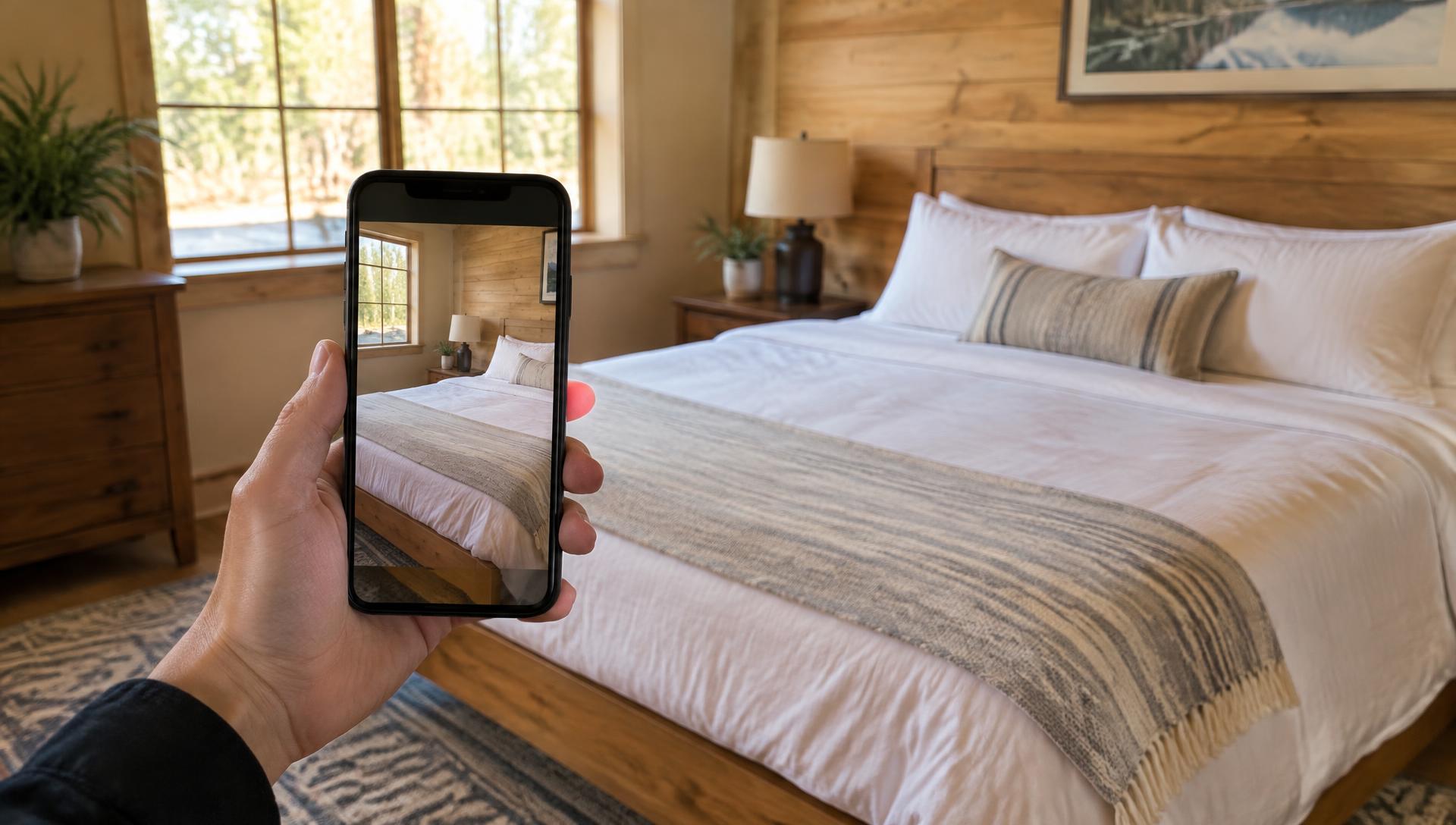
The reference photo does most of the training. "Make the bed" means something different to everyone. A photo of how you want the pillows and throw arranged ends the guessing. When something gets missed, add it to the checklist and the photo list, rather than just sending a text and hoping they remember.
How do you keep a good Airbnb cleaner?
Pay fairly and on time, give them your calendar as early as possible, and make the job predictable. Most cleaners don't leave over one bad day. They leave over months of last-minute surprises and slow payments.
- Share your booking calendar so they see new reservations as soon as they're booked, not the night before.
- Pay on time, every time, on the schedule you agreed.
- Review your rates once a year, and when your own nightly rates go up.
- Warn them early about same-day turnovers, late checkouts and big groups.
- Keep supplies stocked so they aren't stopping at the store on their way in.
- Pass along guest reviews that mention how clean the place was. They earned those.
- Handle problems privately, as a partner. Most misses come from a standard that wasn't clear, not from someone who doesn't care.
- Ask what slows them down. They know your property's problem spots better than you do.
What should you do if your Airbnb cleaner doesn't show up?
Call your backup cleaner. Every host needs at least one backup who has already done a paid clean at your property and can open the same checklist and reference photos. If you don't have one, you're left calling cleaning companies on the morning of a same-day turnover.
To be ready before it happens:
- Line up one or two backup cleaners and pay each for one test clean.
- Keep your checklist and reference photos somewhere a new person can open on their phone.
- Know how you'll get them access, such as a keypad code you can change remotely.
- If the clean will run late, message your arriving guest early with an honest new time. A heads-up at noon goes over far better than a surprise at check-in.
If it does turn into a problem at check-in, here's what to do in the first hour when a guest says your place is dirty.
Make training and backup cleaners easier
Part of why I built Chai was to make "here's what done looks like" easy to hand to anyone. Your cleaner opens a link, with no app or login, and sees your checklist with your reference photo next to each item. If a backup cleaner covers a turnover, you send them the same link. Chai compares their photos to your reference photos and flags anything that doesn't match while they're still there to fix it. There's also a page written for cleaners you can send along. Every account starts with 14 days of Chai Verified, no credit card, and you can get started free.
Frequently Asked Questions
From one host to another
Stay connected for hosting tips +
Chai feature updates
Practical notes for 5-star turnovers, from a fellow short-term rental host.
Get every turnover verified
No credit card. Your first 14 days include everything in Chai Verified. After that, keep using Chai free for as long as you like.